
360 Degree Feedback Course
A 360 assessment needs clear questions, prepared raters and a useful conversation afterwards. In eight recorded lessons, Mike Pritula shows how to define competencies, describe observable behaviour, run the assessment and use the results in development. The course also covers Google Forms and automation options.
- 8 recorded lessons
- Competency and report materials
- Google Forms demonstration
- Homework review
- Diploma
 By Mike Pritula — No. 1 HR instructor on Udemy, 21 years in HR
The job in front of you Sound familiar?
You need a 360 questionnaire, but the competencies are too broad to turn into clear questions.
Employees worry about how the results will be used, and raters need instructions before they respond.
You receive a report full of scores but need to explain what the employee can do with it.
The assessment ends when the report is sent, without development actions or a clear follow-up.
What you will have after the course
A questionnaire based on behaviour
Choose competencies, write observable indicators and select question formats and rating scales. Prepare instructions for raters.
A plan for running the assessment
Organise communication, prepare participants and address response rates and rater bias. Review form settings and reporting options.
A feedback and development approach
Prepare individual or group feedback, explain the results and agree on development actions. Connect the assessment with other HR processes.
| Development area | Method of development | Timing |
|---|---|---|
| Knowledge: Need to know more about budgeting on a zero basis | A three-day course run by Camden Metropolitan University. | June 5 of the following year |
| Skills: The need to develop skills to communicate budget control to managers | Coaching by an accountant-manager | By the end of February next year |
| Competencies: The need for leadership development | Attending the next three-day courses on leadership development in the company | January 15 of the following year |
Start today, for free
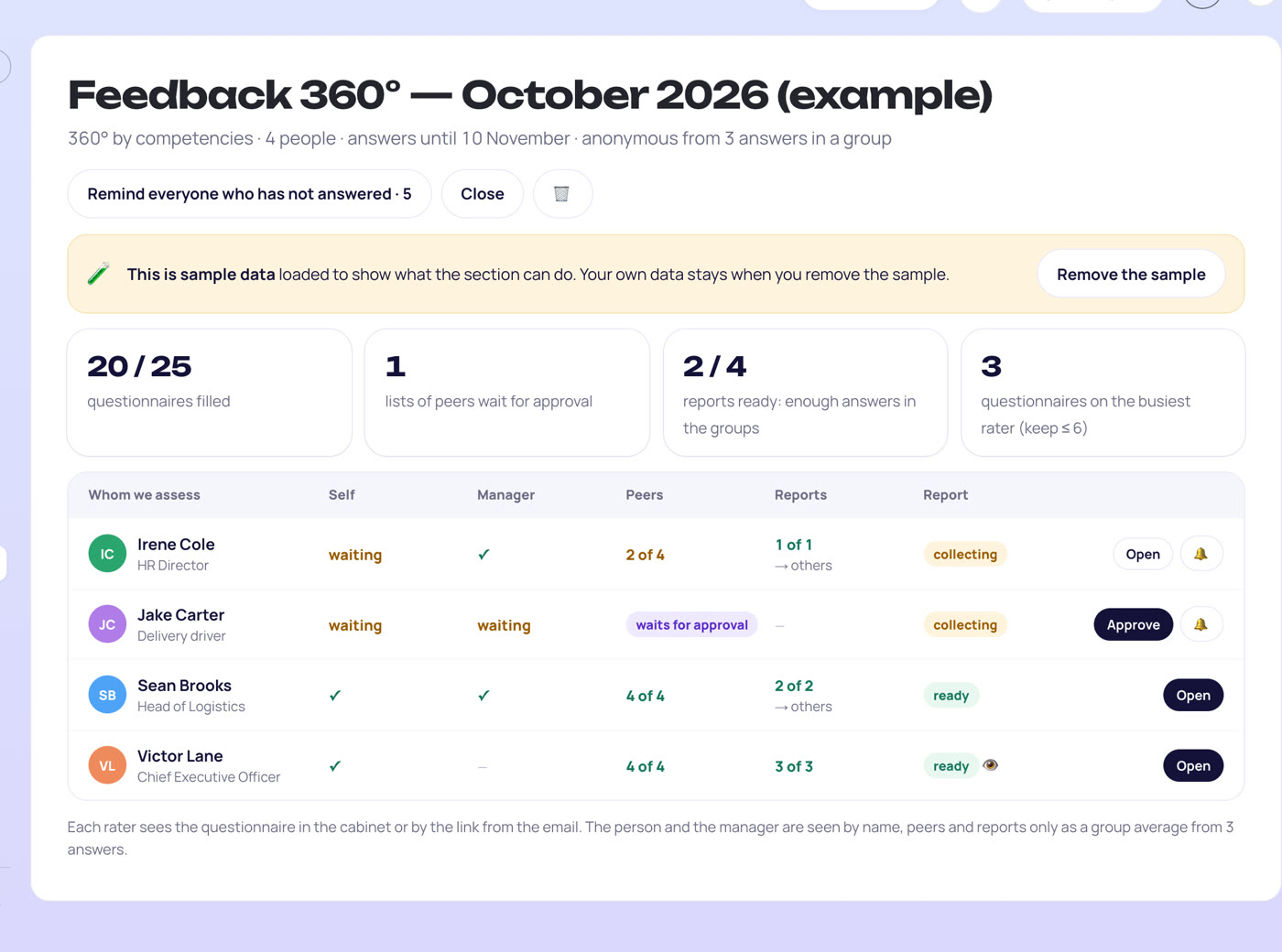
The 360 questionnaire is open in PapaHR: 15 competencies, from leadership and delegation to emotional intelligence, 3 statements each. Compare it with the questionnaire you design in the course.
- Use PapaHR's 360 feedback module to run the assessment within your HR system.
- Use performance reviews to discuss employee performance alongside the behavioural feedback from the assessment.
- Keep development actions as HR documents with the employee's card. In Free you can create 5 HR documents; unlimited in Pro and in the academy subscription.
Tools you get in the course
Competency reference materials
A behavioural competency dictionary and assessment criteria to choose from.
PDF / ExcelRole competency profile examples
Administrator, producer and operator examples to examine when choosing role criteria.
ExcelJob analysis interview materials
An interview questionnaire and analysis workbook to gather evidence about a role.
Word / ExcelQuestion and rating scale guidance
Examples of behaviour descriptions, question formats and response scales in the lesson slides.
Lesson PDF360 feedback sample report
A report document to review when preparing results for the feedback conversation.
WordDevelopment plan example
A filled plan linking knowledge, skills and competencies with development methods and timing.
Lesson PDFAssessment follow-up checklists
Separate next steps for participants, managers and HR after the assessment.
Lesson PDFWho this course is for
HR generalist
needs to organise a first 360 assessment from questionnaire to follow-up
HR business partner
helps managers interpret feedback and agree on development actions
L&D specialist
uses behavioural feedback to plan employee and leadership development
HR director
sets a consistent approach to assessment and its use in HR decisions
Program
01
01 · Lessons 1–2
Define the assessment and its competencies
Distinguish a 360 assessment from other employee surveys. Decide what the questionnaire should assess, identify competency areas and use job information and critical incidents to describe them.
- 1What 360 feedback is: how it differs from company surveys, linking behaviour to performance, why people fear it
- 2Designing the questionnaire: competencies, areas of competence, the critical incident method
Result: A defined assessment purpose and competency structure.
02
02 · Lesson 3
Write the questionnaire
Developing the assessment: behaviour to assess, the letter to raters, rating scales, closed and open questions
Describe observable behaviour, prepare rater instructions and select rating scales. Write closed and open questions, then prepare a pilot before launch.
Result: A questionnaire and instructions ready to test.
03
03 · Lesson 4
Prepare participants and launch
Sending out the questionnaire: how to launch, raising response rates, rater bias
Plan how to introduce and send the questionnaire. Review response rates, survey usability and rater bias. Prepare participants to understand the assessment process.
Result: A communication and launch plan.
04
04 · Lessons 5–6
Discuss results and plan follow-up
Review individual and group reports. Prepare feedback conversations and development actions. Connect the results with leadership development, career planning, performance management and succession planning.
- 5Feedback to employees: one-to-one and group discussions, sample and group reports
- 6Linking 360 to other HR processes: leadership development, careers, performance, succession, training
Result: A structure for feedback and follow-up actions.
05
05 · Lessons 7–8
Set up forms and review automation
Follow the Google Forms lesson on questionnaire creation, settings and reporting. Compare the types of systems that support 360 assessments and review the cases shown in the course.
- 7Google Forms for 360: creating the questionnaire, form settings and reports
- 8Automation systems for 360 and cases of real companies
Result: An understanding of form setup and assessment automation options.
Your profile after the course
What you can add to LinkedIn and your CV — and what this work pays.
Your Name
HR Specialist · 360 feedback and employee development
Experience
Designed a behaviour-based 360 questionnaire and prepared communication, feedback conversations and development follow-up for the assessment.
Licenses & certifications
360 Degree Feedback — Mike Pritula AcademyDiploma after the course
Skills
- 360 Degree Feedback
- Competency Assessment
- Questionnaire Design
- Feedback Conversations
- Development Planning
Medians in the U.S.; pay depends on country, company and experience. * U.S. Bureau of Labor Statistics, May 2025
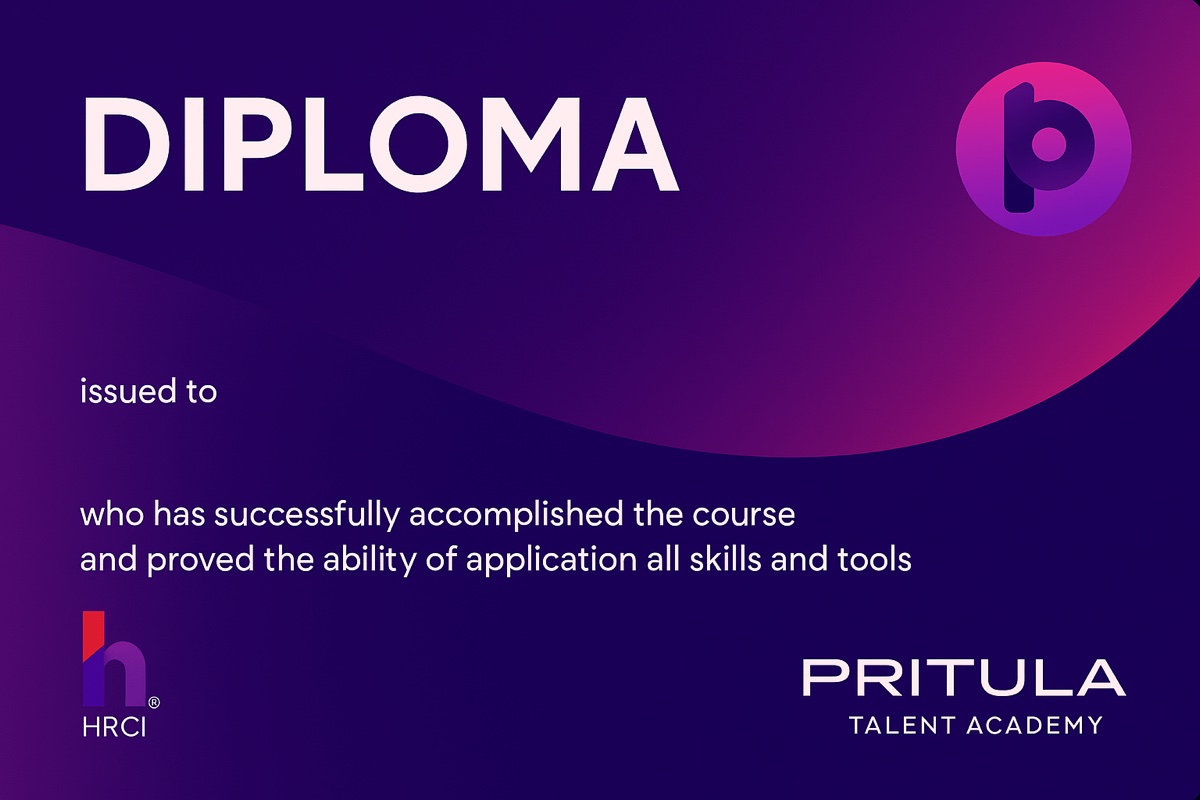
Your diploma after the course
Complete the course assignments and get a personal diploma of Mike Pritula Academy.
- Add it to Licenses & certifications on LinkedIn
- Every diploma has its own unique code
- The QR code on the diploma opens its online version
- Issued on Accredible, the platform Google, Udacity and Rosetta Stone use for their certificates, so it cannot be forged
- Define the assessment and its competencies
- Write the questionnaire
- Prepare participants and launch
- Discuss results and plan follow-up
- Set up forms and review automation
Learn from your phone
Recorded lessons fit into your day: on the way to work, at lunch or in the evening.
- Recorded video lessons — watch at any time
- A year of access, at your own pace
- Competency materials in PDF and Excel, interview and report in Word
- Homework reviewed, Diploma after completing the assignments
Mike Pritula
Founder of Mike Pritula Academy and PapaHR
Mike Pritula founded the academy and built PapaHR, the HR system where the templates of his courses work for real companies. The playbooks are his own HR practice, step by step.
What graduates of the academy say
Graduates of related Mike Pritula Academy courses, from the surveys they fill in when they get the diploma.
“It helped me pick the best candidates more accurately, run more meaningful interviews and focus on exactly the candidates who meet the hiring manager’s requirements.”
Course: Competency-Based Interviewing · Profile on LinkedIn
“The training also changed the way I see my role as an HR professional. I started applying some of the approaches almost immediately — when working with managers and challenging employees, conducting 1:1 meetings and coaching sessions, and resolving workplace conflicts.”
Course: People Partner · Profile on LinkedIn
“HRBP isn’t about “processes for the sake of processes” — it’s about speaking to the business in the language of numbers and strategy. The practical cases helped me roll out new analysis tools while I was still studying.”
Course: HRBP · Profile on LinkedIn
“I noticed I’d become better at reading people’s mood and emotional state, which helped me adjust how I communicate. Without regular practice, knowledge stays just theory.”
Course: Emotional Intelligence · Profile on LinkedIn
Price
for one person, access for a year
- 8 recorded lessons
- Competency materials, sample report and form setup lessons
- Homework review
- Diploma
a year for one person
- All 150+ courses of the academy, this one included
- All playbooks, now and new ones
- Homework review and certificates
- PapaHR Pro for up to 50 employees
a year for a team of up to 10 people
- Everything in the annual subscription
- For up to 10 people of your team
- PapaHR Pro for up to 200 employees
Questions
What should a 360 questionnaire measure?
The course focuses on observable behaviour linked to competencies. It explains how to define competencies and turn them into questions that colleagues can answer from their experience.
How do I prepare people for the assessment?
Lesson 4 covers communication, participant briefings, response rates and rater bias. Explain the purpose and the use of results before sending the questionnaire.
What happens after employees receive the report?
The course covers individual and group feedback, development plans and follow-up by employees, managers and HR. It also explains links with leadership development, careers and other HR processes.
Do I need PapaHR for the course?
No: the course includes materials and a Google Forms lesson. PapaHR is free for up to 25 employees; its 360 assessment module is in Pro.
Do I get a Diploma?
Yes, after completing the course assignments. Homework is reviewed.
What does the annual subscription give?
All 150+ courses of the academy for a year, including this one. You can study the recorded classes at your own pace. The team subscription covers up to 10 people.