
Job Profile Course
A job title and a list of duties do not explain what good performance looks like. In five recorded lessons, Mike Pritula shows how to collect information about a role, describe its results and competencies, and use the profile in recruitment, appraisal and employee development.
- 5 recorded lessons
- Job profile workbook
- Competency and job level references
- Homework review
- Diploma
 By Mike Pritula — No. 1 HR instructor on Udemy, 21 years in HR
The job in front of you Sound familiar?
Job descriptions list tasks but do not explain what result the role is responsible for.
The manager and employee describe the same job differently, and you need a way to compare their answers.
Hiring decisions rely on general impressions because the role has no clear competency criteria.
Recruitment, reviews and development use different expectations for the same position.
What you will have after the course
Information grounded in the job
Use interviews, questionnaires and observation to find out what employees do, whom they work with and what results they must deliver.
A role profile with clear expectations
Describe the purpose, reporting lines, responsibilities, expected results and competencies. Use observable behaviour to explain each competency.
Criteria for people decisions
Turn the profile into a candidate scorecard, appraisal criteria and a development plan. Connect it with career levels and employee goals.
| Negative indicators | Positive indicators |
|---|---|
| Does not achieve the set goals in realistic established deadlines | Achieves goals on time by setting realistic deadlines for achieving them |
| Stops in front of obstacles that arise on the way to achieving the goal | Persistently overcomes difficulties and unforeseen circumstances on the way to achieving the goal |
| Not ready to take risks, avoids responsibility in a situation of uncertainty | Willing to take risks, taking responsibility for actions in a situation of uncertainty |
Start today, for free
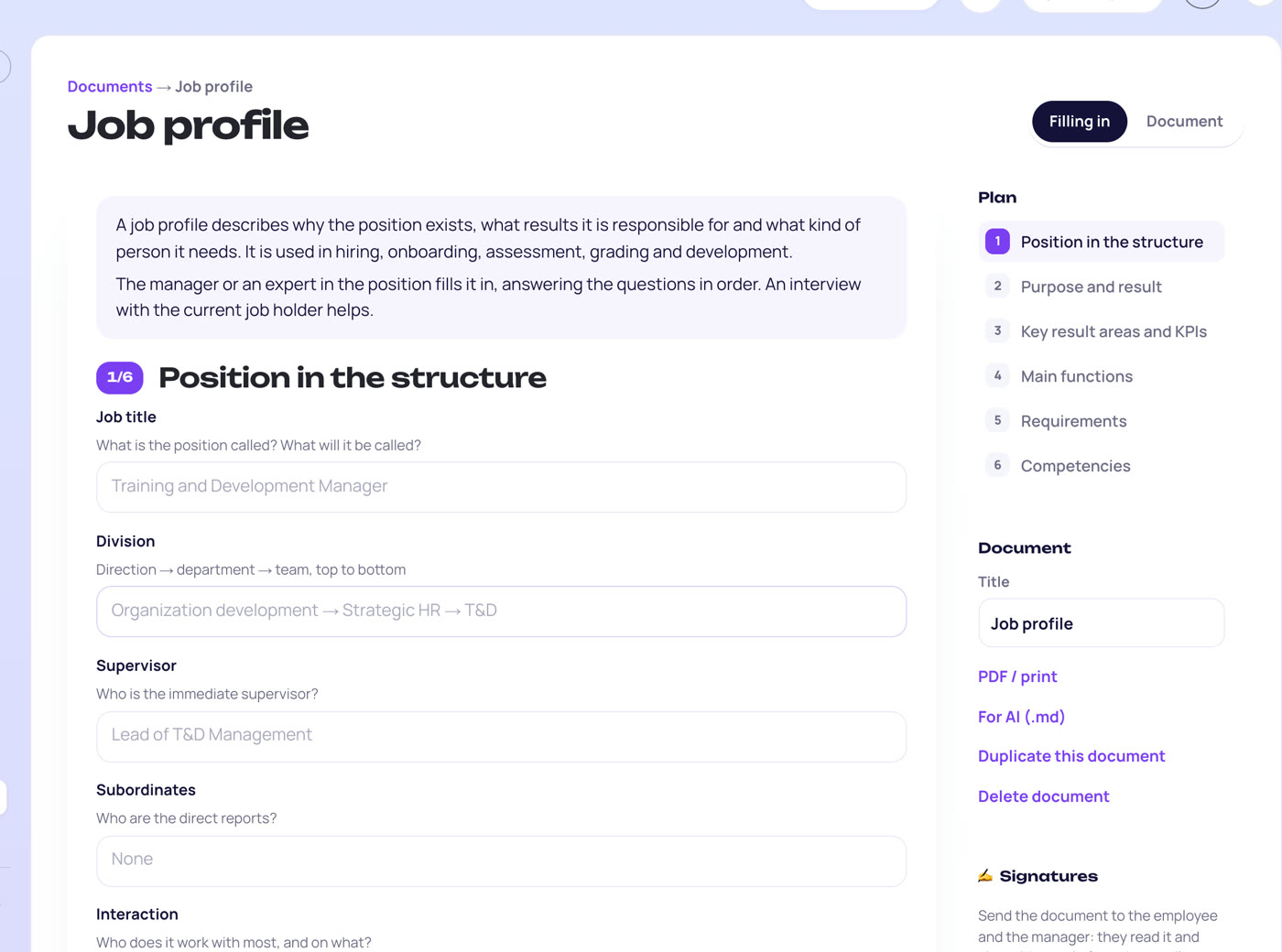
The job profile template is open in PapaHR: why the position exists, what results it is responsible for and what kind of person it needs, on one page. Use it as the base for the profile you write in the course.
- Create a job profile as an HR document in PapaHR and keep it alongside the employee's card.
- Use performance reviews and development documents to apply the expectations you have defined for the role.
- In Free you can create 5 HR documents; unlimited — in Pro and in the academy subscription.
Tools you get in the course
Job profile workbook
A profile template, an example for a training and development manager, and job analysis questions.
ExcelRole analysis interview questions
Ask employees and managers about responsibilities, achievements, difficult situations and working relationships.
Lesson PDFCompetency quality checklist
Check whether competency descriptions are useful and can be recognised in behaviour.
Lesson PDFJob family and level references
Reference matrices of job families and levels to compare the scope of roles.
ExcelWho this course is for
HR generalist
needs clear role descriptions that support everyday HR work
Recruiter
needs job requirements and evidence to use in a candidate scorecard
HR business partner
helps managers agree on role expectations and development needs
HR director
wants consistent role and competency descriptions across the company
Program
Lesson 1. Define the job profile
Learn the parts of a profile, why job analysis comes first and who should contribute. Separate job responsibilities from the competencies needed to carry them out.
Result: A clear structure for the role you need to describe.
Lesson 2. Collect information about the role
Use employee and manager interviews, questionnaires and observation. Examine responsibilities and interactions, including how the job fits into company processes.
Result: Information you can use to write the profile.
Lesson 3. Describe competencies
Research the behaviours that support successful performance. Use interviews, critical incidents and other methods to define competencies and their indicators.
Result: Competency descriptions based on observable behaviour.
Lesson 4. Use libraries and role references
Review competency libraries and ready job descriptions. Learn how to adapt reference material to the company rather than using it without checking the context.
Result: A selection of relevant references for your role profile.
Lesson 5. Apply the profile
Use role criteria in a candidate scorecard, career ladder, development plan and performance assessment. Connect competencies with employee goals and KPIs.
Result: A plan for using the profile in hiring, reviews and development.
Your profile after the course
What you can add to LinkedIn and your CV — and what this work pays.
Your Name
HR Specialist · Job profiles and competency models
Experience
Prepared role expectations and behavioural competency criteria, with a plan to use the profile in hiring, employee reviews and development.
Licenses & certifications
Job Profile — Mike Pritula AcademyDiploma after the course
Skills
- Job Analysis
- Job Profiles
- Competency Models
- Candidate Scorecards
- Development Planning
Medians in the U.S.; pay depends on country, company and experience. * U.S. Bureau of Labor Statistics, May 2025
Your diploma after the course
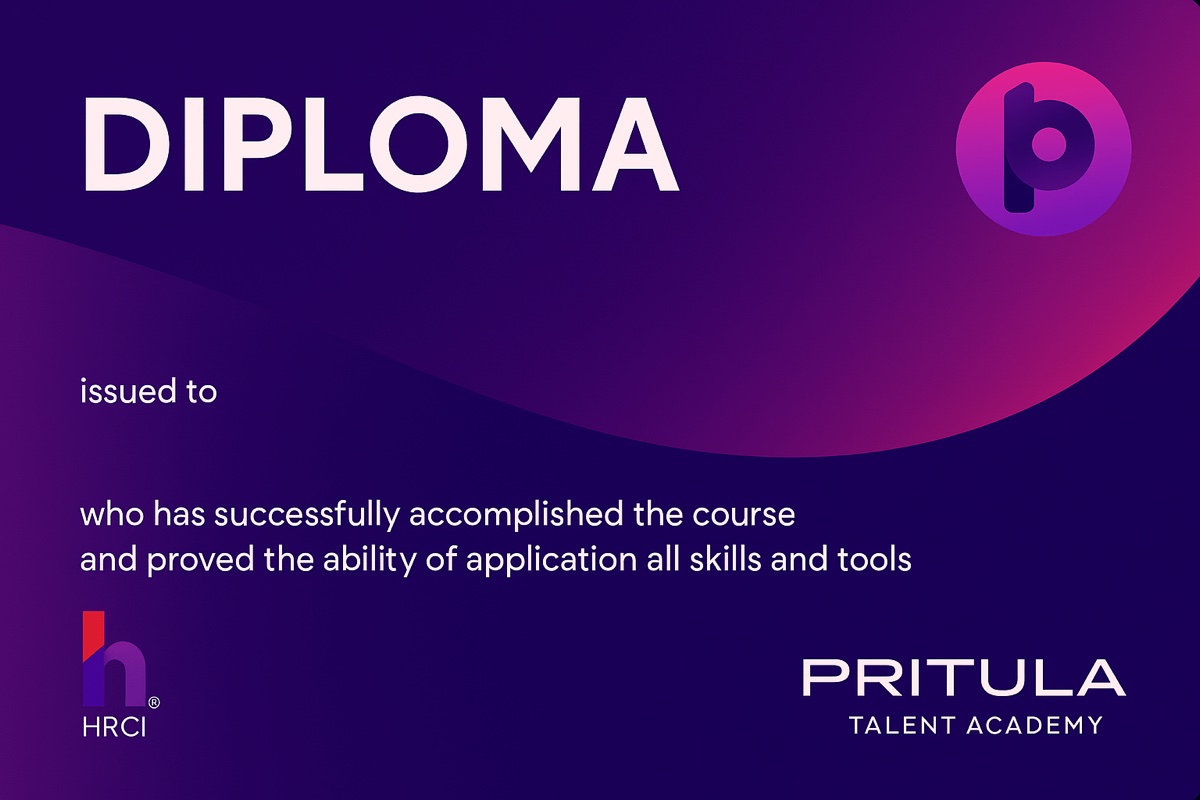
Complete the course assignments and get a personal diploma of Mike Pritula Academy.
- Add it to Licenses & certifications on LinkedIn
- Every diploma has its own unique code
- The QR code on the diploma opens its online version
- Issued on Accredible, the platform Google, Udacity and Rosetta Stone use for their certificates, so it cannot be forged
- Lesson 1. Define the job profile
- Lesson 2. Collect information about the role
- Lesson 3. Describe competencies
- Lesson 4. Use libraries and role references
- Lesson 5. Apply the profile
Learn from your phone
Recorded lessons fit into your day: on the way to work, at lunch or in the evening.
- Recorded video lessons — watch at any time
- A year of access, at your own pace
- Job profile workbook, Excel references and PDF slides
- Homework reviewed, Diploma after completing the assignments
Mike Pritula
Founder of Mike Pritula Academy and PapaHR
Mike Pritula founded the academy and built PapaHR, the HR system where the templates of his courses work for real companies. The playbooks are his own HR practice, step by step.
What graduates of the academy say
Graduates of related Mike Pritula Academy courses, from the surveys they fill in when they get the diploma.
“It helped me pick the best candidates more accurately, run more meaningful interviews and focus on exactly the candidates who meet the hiring manager’s requirements.”
Course: Competency-Based Interviewing · Profile on LinkedIn
“As a newcomer to the field, I found literally everything useful. It was substantial, interesting and new to me.”
Course: HR Specialist · Profile on LinkedIn
“I liked that the homework let me put what I learned into practice right away. Lots of documents I’ll be able to use later.”
Course: Talent Acquisition Manager · Profile on LinkedIn
“It helped me look at HR systematically — as a business function rather than a set of separate processes. What’s especially valuable is that every topic was backed by practical tools, calculations and real management cases, so I could apply it at work straight away.”
Course: HR Generalist · Profile on LinkedIn
Price
for one person, access for a year
- 5 recorded lessons
- Job profile workbook, role references and lesson materials
- Homework review
- Diploma
a year for one person
- All 150+ courses of the academy, this one included
- All playbooks, now and new ones
- Homework review and certificates
- PapaHR Pro for up to 50 employees
a year for a team of up to 10 people
- Everything in the annual subscription
- For up to 10 people of your team
- PapaHR Pro for up to 200 employees
Questions
How is a job profile different from a list of duties?
The profile also describes the role's purpose, expected results, working relationships and competencies. It gives HR and the manager criteria for hiring, evaluation and development.
Do I need to interview employees?
Interviews are one of the methods covered. The course also explains manager interviews, questionnaires and observation, so you can choose how to collect information for the role.
Can I use a ready competency library?
Yes, as reference material. Lesson 4 explains how to select and adapt descriptions. The profile still needs to reflect the work and behaviour expected in your company.
Do I need PapaHR for the course?
No: the course includes a job profile workbook, reference workbooks and lesson materials. PapaHR is free for up to 25 employees and lets you keep job profiles as HR documents.
Do I get a Diploma?
Yes, after completing the course assignments. Homework is reviewed.
What does the annual subscription give?
All 150+ courses of the academy for a year, including this one. You can study the recorded classes at your own pace. The team subscription covers up to 10 people.